
Exercise Bike vs Treadmill: How to Choose for Your First Cardio Sessions
The useful comparison is not which machine displays more calories, but which task you can learn and repeat comfortably. Check bike fit and treadmill operation, consider your actual gym schedule, and keep medical pain or rehabilitation decisions outside a generic equipment ranking.
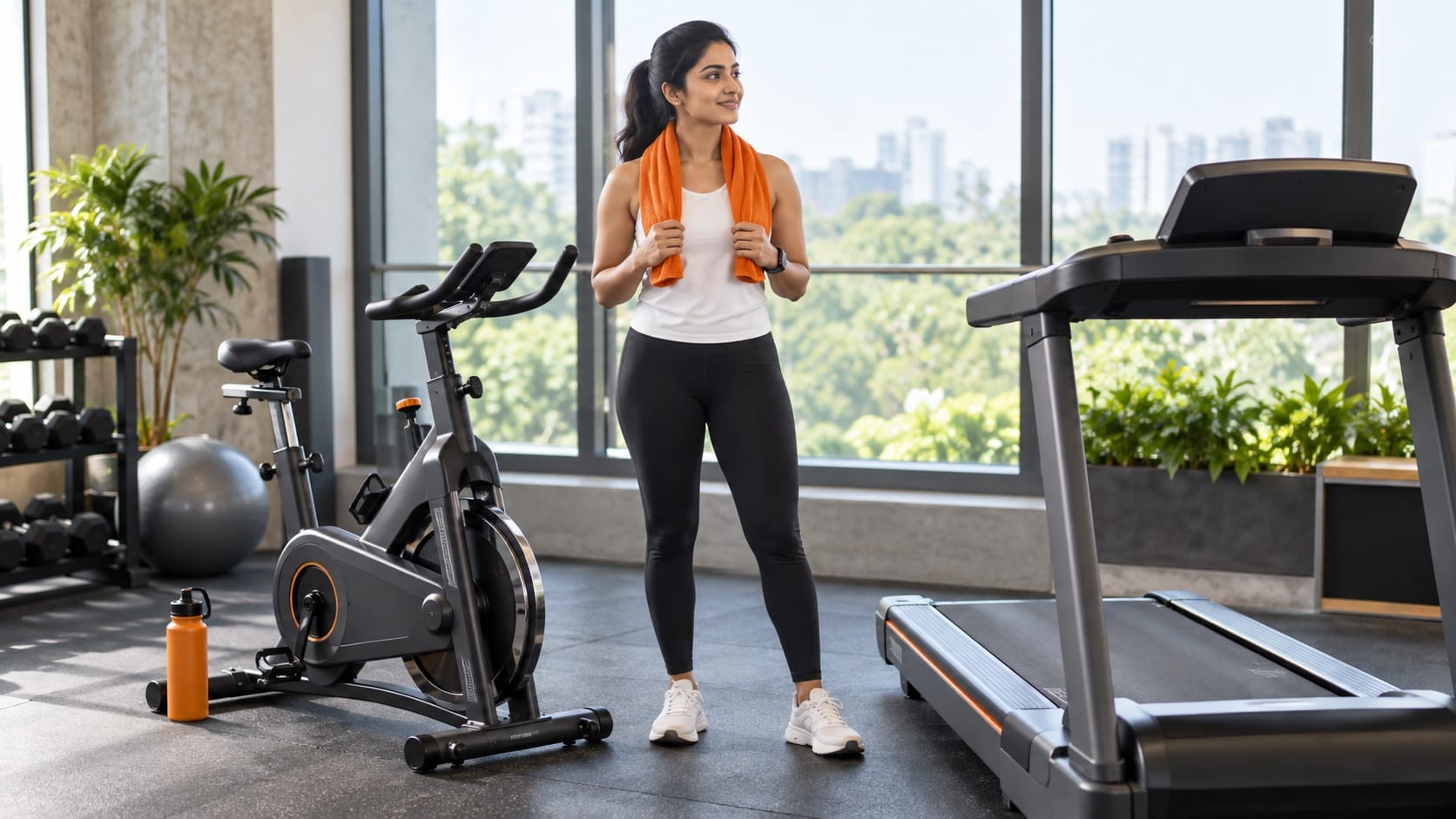
Choose between an exercise bike and a treadmill by comparing the task you can learn, adjust and repeat. A bike involves pedalling from a seat; a treadmill involves walking or running on a moving belt. Neither is the universal best first cardio machine.
For a beginner, fit, operating confidence, enjoyment and availability are more useful starting criteria than the largest calorie display. This guide compares the options for general exercise, not pain management, rehabilitation or a medical condition.
Start with what you want to do
If your aim is to walk indoors without planning an outdoor route, treadmill walking may match that preference. Running is a separate choice; you do not have to run to use a treadmill. If you enjoy pedalling and prefer a seated task, a correctly fitted bike may be worth learning.
Preference does not replace instruction. Write down the practical requirement: 'I want a manageable indoor walk' or 'I want a seated pedalling option I understand.' That is clearer than asking which machine is best for everybody.
| Decision | Bike question | Treadmill question |
|---|---|---|
| Fit and access | Can I mount, adjust and use this seat and pedal arrangement? | Do I understand the intended entry and belt-start sequence? |
| Effort control | How do resistance and my pedalling pace interact? | How do belt speed and incline controls work? |
| Stopping | What is this model's controlled stopping procedure? | Where are normal and emergency stop controls? |
| Availability | Is the bike I learned usually available? | Is the treadmill area usable at my normal time? |
Exercise bikes are not all the same
An upright bike, a recumbent bike and an indoor cycle can have different seats, pedals and resistance systems. Do not treat a demonstration of one as instructions for every other seated cardio machine. Check the nameplate and model with staff.
The official Atmos Home upright-bike instructions require getting off before adjusting seat height and checking that the knob has engaged. The Atmos Home recumbent instructions describe a forward/backward seat slide with a spring-loaded handle and a locking check. Neither allows adjustment while pedalling.
These are useful real differences, not a recommended brand or a claim about partner-gym stock. Ask for the matching instructions for the actual bike rather than copying which side a handle appears on in a photo.
Check the fit before adding effort
The two Atmos references describe maintaining a slight knee bend at the fullest leg extension rather than locking the knee or shifting in the seat. That is guidance for those models, not a universal saddle number or a diagnosis of discomfort.
Ask someone to check your reach to the pedals, seat locking, intended hand support and any pedal straps. You should understand how to get off before trying a longer or harder effort. A seat that slides after being locked needs staff attention, not another test ride.
If a position causes pain, stop and seek appropriate advice. Do not conclude from this comparison that cycling treats the problem or that moving a saddle diagnoses it. Persistent or recurring pain needs healthcare assessment.
The treadmill has a different operating task
Ask staff to explain units, belt speed, incline, normal stop, any emergency tether and the intended entry and exit. Learn those before selecting a preset programme. A programme name does not tell you whether its automatic changes suit you.
The Life Fitness Atmos treadmill safety page explains its magnetic emergency tether and distinguishes it from pausing or ending a session with STOP. It is a model-specific example, not a guarantee that every treadmill shares the mechanism.
Familiar controls matter more than a higher setting. If you cannot confidently identify how to stop the belt, orientation comes before the comparison of workout intensity.
Compare effort rather than unlike display numbers
A bike resistance level is not equivalent to a treadmill incline number. Bike distance and treadmill distance describe different equipment tasks. Matching either number does not establish equivalent effort or outcomes.
The CDC's relative-intensity guidance offers a simpler clue: moderate aerobic effort usually leaves conversation possible, whereas more vigorous activity makes speaking harder. Check your response to the activity rather than assuming one screen setting defines intensity for everybody.
That is not a medical clearance test. You may keep effort lower while learning the machine. You also do not need to make the bike and treadmill equally demanding during your first orientation just to compare them.
A practical comparison record
After learning an option, make a short note about what was clear and what remains unresolved. Compare those notes at a later visit rather than trying to finish two demanding sessions back to back for a verdict.
- Access: Was mounting and dismounting explained clearly?
- Fit: Could the equipment be adjusted appropriately for the task?
- Controls: Did you understand how to change effort and stop?
- Preference: Did you enjoy the movement enough to choose it again?
- Practicality: Was it available at the time you normally attend?
If either option remains uncomfortable or unclear, resolve the fit or operating question before declaring a winner.
Three everyday choices
You want an indoor walking option. Learn treadmill walking if it fits your circumstances and equipment access. The walking-versus-gym guide explains why an outdoor route may also be practical; purchasing access is not compulsory for walking.
You prefer a seated task. Ask which bike type is available and have its fit checked. A recumbent seat is a different arrangement, not automatic proof that it is medically appropriate for you.
Your preferred machine is often occupied. Ask whether a second option can be taught as an alternative. Do not assume an unlearned machine is equivalent just because it is free.
Fit the choice into the rest of the visit
If you also lift, decide whether this activity is preparation or a separate cardio session. The cardio-before-or-after-weights guide addresses that ordering question. Machine preference alone does not determine where the activity belongs.
Consider footwear and venue rules too. The gym-footwear comparison helps you ask relevant questions without requiring a particular product. You do not need new equipment merely to make a first cardio-machine decision.
Stop if you feel pain or unwell and obtain help. For sudden persistent chest discomfort or chest pain with breathlessness, seek emergency assistance; NHS advice supports prompt escalation, not switching machines to see whether the symptom disappears.
Compare Fit Square gym listings for convenient venues and ask about the cardio models and orientation available. Use the Fit Square app to check eligible partner access. Equipment, hours and coaching need direct confirmation; access is not an exercise prescription.
Manufacturer and guidance links
- Life Fitness: upright-bike fit and adjustment
- Life Fitness: recumbent-bike adjustment
- Life Fitness: treadmill emergency stop
- CDC: activity intensity
- NHS: chest-pain guidance
Bike or treadmill questions
Must I run on a treadmill?
No. Walking is a separate option; learn the settings appropriate to that task.
Is a recumbent bike automatically best for joint pain?
No. Pain and rehabilitation decisions need individual advice, not a generic equipment ranking.
Can I match the resistance and incline numbers?
No. Those controls describe different equipment tasks, not a common effort scale.
Can I alternate between them?
Yes, if you have learned both and the arrangement suits your plan. Alternating is an option, not a requirement.