
How to Read an Indian Nutrition Label: Per Serving vs Per 100 Grams
Start with the quantity behind the numbers, then calculate what you actually eat. A fictional packet example explains serving sizes, whole-pack totals, product comparisons and ingredient checks, without treating reference allowances as personal dietary targets.
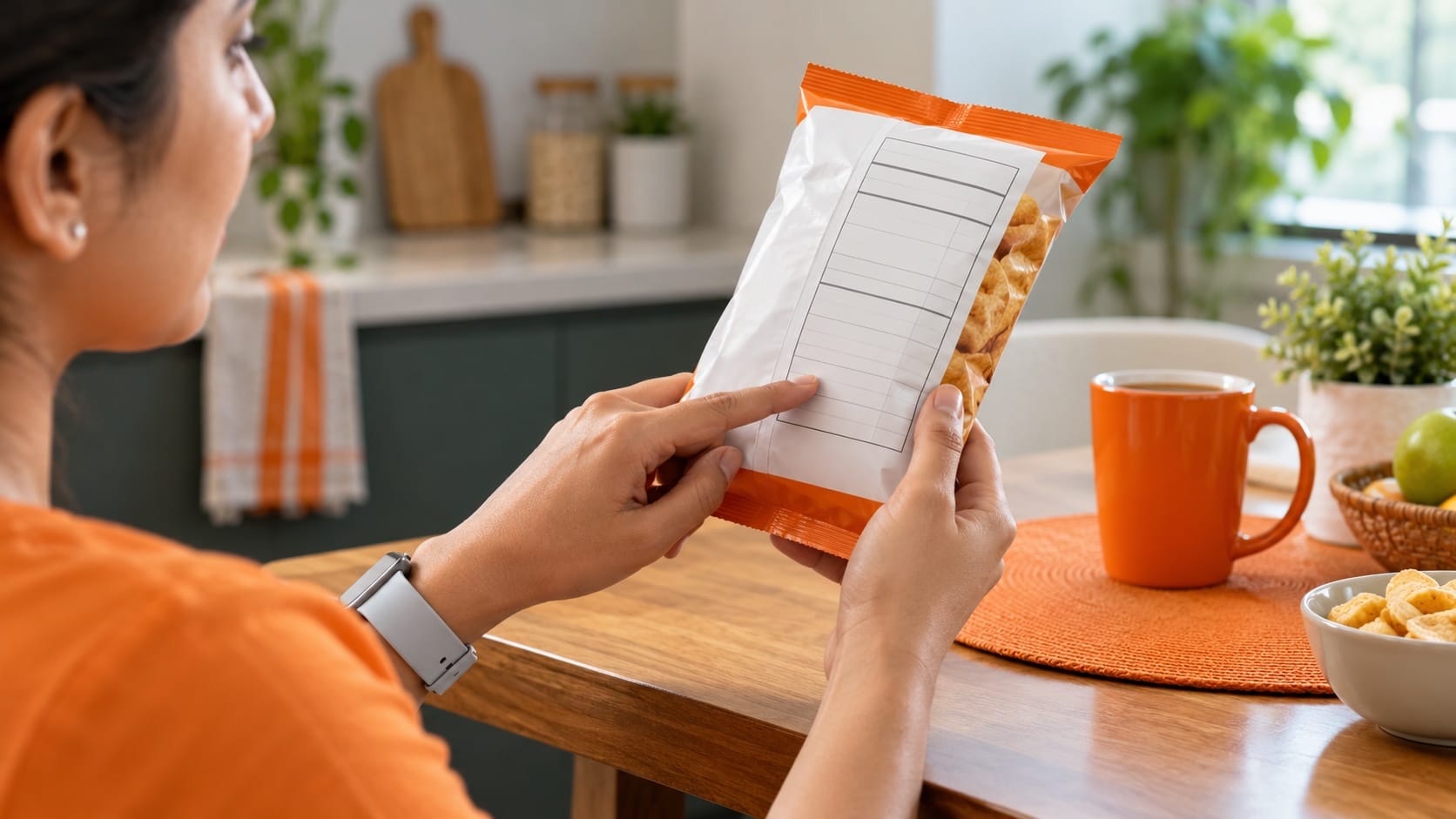
To read a nutrition label, first find the amount the numbers describe: per 100 g, per 100 ml, per serving or per single-consumption pack. Then calculate the amount you actually eat. A 60 g packet with a 30 g labelled serving contains two servings; eating the whole packet means doubling the per-serving figures.
This simple check prevents many misleading comparisons. It also helps you separate a product's measured composition from a front-of-pack claim such as high protein or no added sugar. You do not need to become a full-time food tracker to compare two packets sensibly.
Find the quantity behind each column
Look for per 100 g, per 100 ml, per serving or per pack, then check the pack size and the amount you eat. FSSAI labelling guidance and its Eat Right India consumer guide explain these quantity checks; reference percentages describe standard allowances, not your personal dietary needs.
Work from the amount actually eaten
The following is an original fictional teaching panel for a savoury snack, not a real product or a recommended portion. The packet weighs 60 g and its example serving is 30 g. The table intentionally shows the same information on three quantity bases.
| Item | Per 100 g | Per 30 g example serving | Per 60 g whole packet |
|---|---|---|---|
| Energy | 460 kcal | 138 kcal | 276 kcal |
| Protein | 20 g | 6 g | 12 g |
| Carbohydrate | 50 g | 15 g | 30 g |
| Total sugars | 12 g | 3.6 g | 7.2 g |
| Added sugars | 8 g | 2.4 g | 4.8 g |
| Total fat | 20 g | 6 g | 12 g |
| Saturated fat | 6 g | 1.8 g | 3.6 g |
| Sodium | 500 mg | 150 mg | 300 mg |
The calculation is per-100 value multiplied by grams eaten, divided by 100. For the whole packet's protein, 20 multiplied by 60 divided by 100 equals 12 g. For a 45 g amount, the same calculation gives 9 g protein and 207 kcal.
There is no suggestion that 30 g or 45 g is the right portion for you. The serving is a measurement reference. Your amount may differ, and a partly eaten packet needs the amount consumed rather than the amount bought.
Compare products on the same basis
Suppose fictional product A lists 6 g protein in a 30 g serving, while product B lists 8 g in a 50 g serving. The larger headline makes B appear higher in protein, but A provides 20 g per 100 g and B provides 16 g per 100 g. A is more concentrated in this example.
Now compare an actual 30 g quantity of each: A supplies 6 g protein, B supplies 4.8 g. If you eat 50 g of B, you get its stated 8 g. Both concentration and the amount eaten are useful; neither alone determines which product suits your meal, budget or health.
Keep the comparison within the same food category where practical. Per-100 g figures are less useful for declaring a dry powder superior to a ready-to-eat meal with substantial water. They describe composition, not whether the foods perform the same job. For that wider decision, see protein needs for gym beginners.
Check liquids and prepared products separately
If a drink gives values per 100 ml and you consume 250 ml, multiply by 2.5. Do not silently convert millilitres to grams across different foods. The quantity unit should match the panel's basis.
For powders, soups and mixes, look for wording that distinguishes as sold from as prepared. A dry mix weighed before adding water is not the same mass as the finished dish. If a prepared figure already includes the instructed milk, adding milk again to your estimate double-counts it. If the figure is for powder only, milk contributes separately.
Likewise, a drained canned-food weight can differ from the pack's total contents. Check whether the values describe drained food or food with liquid. When the basis is unclear, seek clarification rather than invent a precise interpretation.
Read the panel as a meal decision, not one score
Energy, protein, carbohydrate, sugars, fat and sodium answer different questions. Carbohydrate includes more than sugars; added sugars are part of total sugars, not an extra amount to add on top. Saturated fat is included within total fat. Summing all those rows would double-count components.
Sodium and salt are not interchangeable numbers. Labels may use different terms, and milligrams are not grams. First notice the units and compare the same measure; do not compare 300 mg sodium directly with 0.3 g salt as though they are the same quantity.
The reference allowances behind percentage figures are standard label references, not an individual meal plan. A product showing part of a reference day's energy does not establish your daily needs. Nor is a larger percentage a universal sign of a better food.
A useful question is what the product adds to the occasion. If it is replacing a meal, does it supply enough variety to do that job? If it is a snack before exercise, will its portion and ingredients feel comfortable? Our pre-workout food guide separates that timing question from label arithmetic.
Turn the packet to ingredients and allergens
Read the ingredients as well as the nutrient panel. A front claim does not tell you everything included, and two similarly named products may have different recipes. Check the separate allergen declaration and any cross-contact warning. Milk, soy, nuts or an identified cereal may matter even when you are interested mainly in protein.
If you have a diagnosed allergy, follow your care plan; a favourable protein number does not make the product suitable. Avoid guessing that a product is allergen-free because its front looks plain or its vegetarian symbol is present.
Date and storage information are also part of a useful shopping decision. A product that requires refrigeration cannot be carried unrefrigerated all day simply because its nutrition panel seems attractive. A manufacturer's or seller's online description may not match a newer flavour or reformulated pack, so check the item in hand.
Do not let a front claim make the whole decision
No added sugar does not mean no naturally occurring sugar, no energy or suitability for every medical diet. A high-protein claim does not tell you the amount in your actual portion. Natural, fitness and similar words also do not substitute for the ingredients and quantity information.
Use labels to answer a specific question, then stop. It can be enough to compare two curds or check what one packet contributes. You do not need to optimise every nutrient at every meal. The broader muscle-gain habits guide helps keep one product in perspective.
For a beginner, everyday organisation often matters more than another packaged-food purchase. Pair food arrangements with a realistic first-month gym routine. Compare convenient venues in the Fit Square gym directory, and use the Fit Square app for eligible access rather than assuming it assesses your diet.
References
FSSAI Labelling and Display Regulations compendium; FSSAI Eat Right India label-reading guide.
Label-reading questions
Is a packet always one serving?
No. Check pack quantity and serving size. A 60 g packet with a 30 g serving contains two example servings.
Should I compare per serving or per 100 g?
Use a common per-100 basis for concentration, then calculate the portion you actually eat. Different serving sizes can distort a headline comparison.
Do I add total sugars to carbohydrate?
No. Sugars are included within carbohydrate, and added sugars are included within total sugars. Do not count them twice.
Are the panel numbers a personal prescription?
No. They describe the product and standard reference contributions. Your individual dietary needs require a separate assessment.