
Sets, Reps and Rest: How to Read Your First Workout Plan
Decode a workout card without guessing. Understand sets, repetitions, rest, per-side counts and effort notes through a clearly labelled worked example.
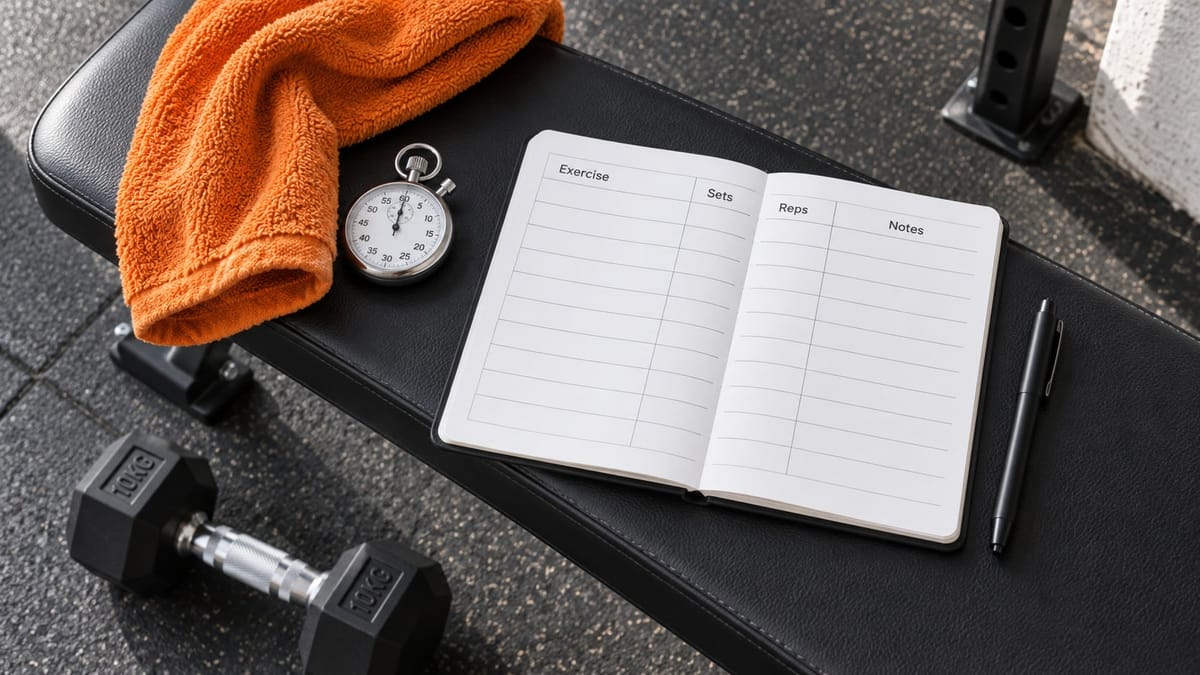
In a workout plan, a rep is one complete repetition of an exercise, a set is a group of repetitions, and rest is the break between groups of work. '2 sets of 10 reps, rest 90 seconds' means do 10, rest, then do another 10. It does not mean 20 uninterrupted repetitions.
The trainer-written glossary from Life Time explains these basic terms. Understanding them is useful; treating a copied set-and-rep scheme as the right prescription for every adult is not. This guide teaches you to read a plan, not to choose a complete programme or train through symptoms.
What does one line of a workout card tell you?
Here is a made-up workout-card entry used only to explain notation:
Seated row: 2 sets x 10-12 reps; rest 90 seconds between sets; resistance chosen with instruction.
| Part of the entry | What it means here | What it does not tell you |
|---|---|---|
| Seated row | The named exercise. | Which machine, attachment or setup your gym uses. |
| 2 sets | Two separate groups of work. | Whether any preparation sets are included. |
| 10-12 reps | A range for each set, not 10 on one day and 12 on another. | The appropriate resistance or effort for you. |
| 90 seconds between sets | The example's planned break after the first set. | A universal recovery time for all exercises or people. |
| Resistance chosen with instruction | Load still needs to be established. | A kilogram value you should guess from someone nearby. |
If your card instead says '10 x 3' with no headings, do not rely on convention to settle whether that means ten sets of three or three sets of ten. Ask the person who wrote it to label the columns. A plan should remove ambiguity before you begin.
How do you follow that line from start to finish?
Once you have learned the exercise and agreed on the setup and load, read the example as a sequence:
- Complete the preparation you were instructed to do.
- Perform the first working set within the prescribed range, without forcing repetitions when your stopping criteria are reached.
- Finish and put the equipment into its resting position.
- Take the planned break, then reassess whether you are ready for the next set.
- Perform the second set and record what you actually did.
In an illustrative log, completing 12 repetitions followed by 10 gives 22 completed repetitions. Writing '2 x 12' would incorrectly record 24. Recording 12 and 10 separately preserves what happened. You have not failed the notation test because both sets were not identical.
If you stop below the target, note that rather than adding rushed repetitions later to repair the total. Tell your coach if the load, technique, discomfort or instructions need attention. Pain is not a missing number to make up.
Are warm-up sets included in the total?
They may be listed separately, or a poorly labelled card may leave you guessing. A warm-up set is preparation for the planned exercise; a working set is part of the main work the card asks you to record. Ask which is which.
For example, a card might list 'one preparation set, then two working sets'. You would carry out three sets in total but log two as working sets. That arithmetic does not establish how many warm-up sets you personally need or what their loads should be.
If the exercise name is familiar but the machine is not, resolve setup first. Our gym-machine guide explains what to ask about seats, pads and resistance controls.
Does '10 reps each side' mean ten or twenty?
It means ten on each side: twenty individual side-specific repetitions. For a plan that explicitly says 'ten alternating repetitions total', the same sequence would usually be five per side. Those are different instructions, so the card should say which it intends.
Also ask where the rest belongs. 'Left side, right side, rest' is not the same sequence as resting after each side. You do not need to infer that from the exercise name.
A timed exercise is different again. '2 x 20-second hold' means two holds lasting up to the instructed time, separated by the specified break. It does not mean twenty repetitions. The duration remains a target to adapt, not permission to continue through pain or loss of position.
What do tempo, effort and RIR mean?
Tempo describes movement speed. A coach may write it in words or use a multi-number code for lowering, pauses and lifting. Because code order can be unclear, ask for an explanation in plain language rather than guessing. ACE's programme-design reference distinguishes tempo, resistance, repetitions, sets and rest as separate variables.
RIR means repetitions in reserve: an estimate of how many more repetitions you could perform with good technique. A note of '2 RIR' means stop with an estimated two remaining, not perform two extra repetitions. The definition is explained in Newcastle Hospitals' exercise guide. It is an estimate, not a safety certificate or a number you must prove by continuing to failure.
RPE means rating of perceived exertion. If your card uses it, ask which effort scale the writer is using and what its anchors mean. Do not assume every number out of ten describes the same thing as a whole-session effort rating. You can ask for ordinary wording, such as how the final repetitions should feel and when to stop.
Should you finish one exercise or move around a circuit?
A plan of straight sets commonly means completing the listed sets of one exercise, with breaks, before moving on. A circuit asks you to move through a sequence of exercises and then repeat the sequence. A superset pairs exercises. These labels describe organisation, not a reason to omit all rest.
For instance, 'A1' and 'A2' may identify a pair, but the labels alone do not state the rest intervals. Ask whether you alternate, when you rest, and what to do if one station is occupied. Agree on an alternative rather than holding two busy machines while trying to decipher the card.
What if the plan leaves rest blank?
Ask the writer to supply an interval and explain when to extend it. ACE's programme-design guidance notes that rest depends on the load and training outcome. The 90-second interval in our example is there to make the notation concrete, not to settle your rest needs.
Between-set rest and rest days also answer different questions. The first concerns repeated work within a session; the second concerns scheduling sessions across the week. For that separate decision, read how many gym days to plan.
What should you ask before using the plan alone?
- 'Which exact exercise or machine does this name refer to?'
- 'Are these working sets, and what preparation goes before them?'
- 'Are repetitions per side or total?'
- 'How should the resistance be chosen and recorded?'
- 'When do I rest, and what are my stopping criteria?'
- 'What is the agreed alternative if the equipment is unavailable?'
Keep the answers beside the workout rather than in a separate message you must find mid-session. For venue planning, use the Fit Square app to find compatible gym options and ask whether the equipment your plan needs is available. Access does not automatically include a personalised programme or personal training; confirm those services separately.