
Vegetarian Protein Foods for Gym Beginners: Compare Real Portions
Compare dal, chana, paneer, milk and other vegetarian foods by the portion you actually eat. See why dry and cooked weights differ, how to check packaged products and how to build ordinary meals without relying on protein powder.
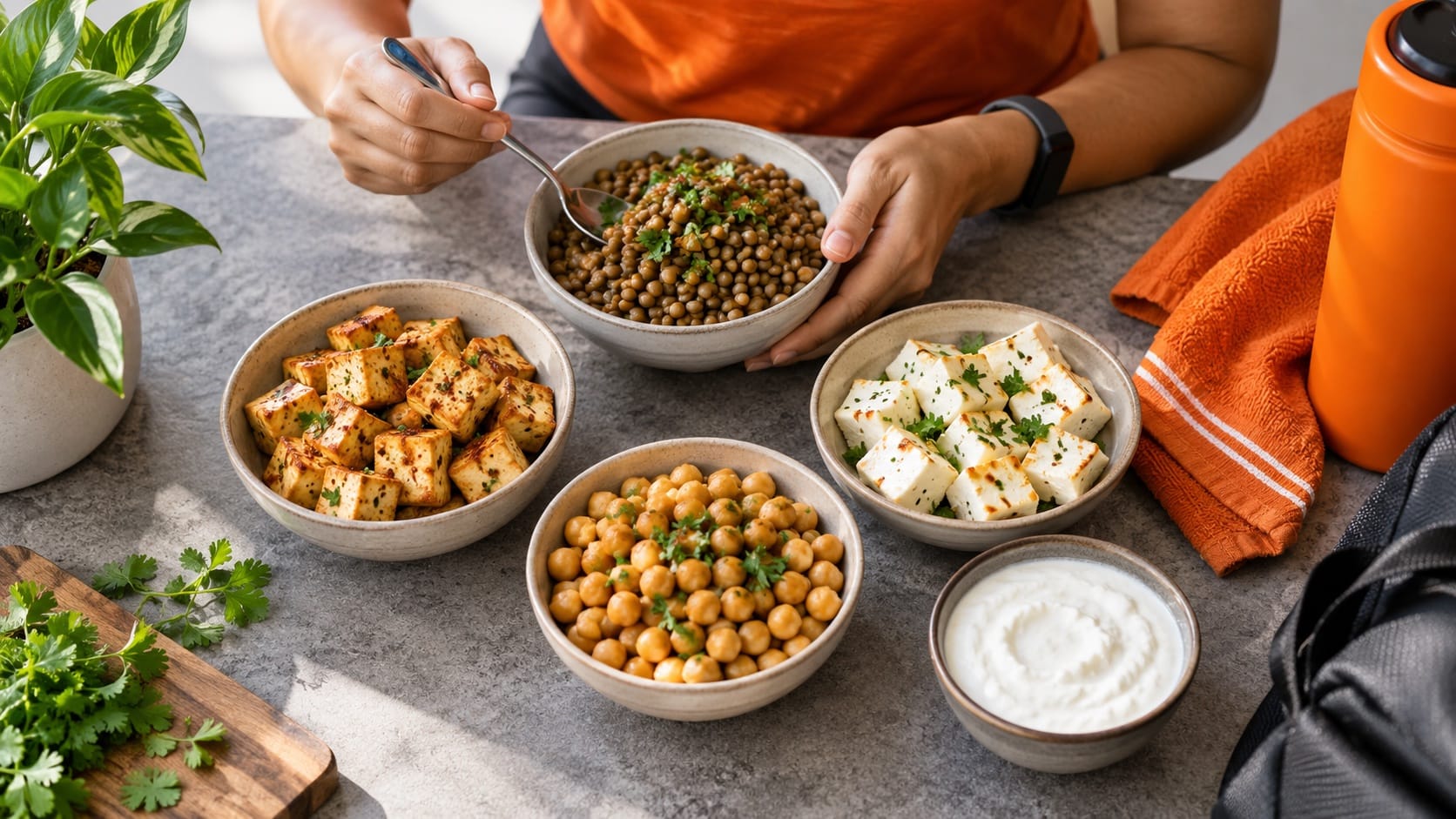
Dal, beans, paneer, tofu, milk and curd can all contribute protein to a vegetarian gym routine. The useful comparison is not a list of foods ranked per 100 grams: it is how much you actually eat, whether that weight is dry or cooked, and what else comes with the serving. A small garnish of paneer and a substantial paneer dish are different meals.
Start by identifying a recognisable protein-containing food in your ordinary meals. This guide helps compare foods, not prescribe a daily target. For the separate question of requirements, read how much protein gym beginners need.
Compare the food you will actually eat
The Indian Food Composition Tables, or IFCT 2017, report amounts per 100 grams of edible food. Most entries describe raw foods; a dry pulse entry is not a cooked-dal entry. Energy in the tables is given in kilojoules, converted here to kilocalories by dividing by 4.184. Values below are rounded estimates, not laboratory measurements of your meal.
| Food and portion | Approximate protein | Approximate energy | What the estimate includes |
|---|---|---|---|
| Cooked masoor made from 50 g dry lentil dal, entire preparation eaten | 12.2 g | 161 kcal | Dry lentil ingredients only; added oil and other ingredients excluded |
| Cooked moong dal made from 50 g dry split green gram, entire preparation eaten | 11.9 g | 163 kcal | Dry moong ingredients only; not 50 g of cooked dal |
| Cooked chana made from 50 g dry whole Bengal gram, entire preparation eaten | 9.4 g | 144 kcal | Ingredient-based estimate; draining and cooking losses can alter it |
| 75 g plain paneer, weighed before adding to a dish | 14.1 g | 229 kcal | IFCT paneer average; gravy, oil and actual product variation excluded |
| 200 g whole cow's milk | 6.5 g | 146 kcal | Milk by weight, not a claim that every 200 ml carton has these values |
| 20 g plain almond kernels | 3.7 g | 122 kcal | IFCT almond entry; coating or added oil excluded |
The servings are comparison examples, not recommended quantities for everyone. Pulses also supply carbohydrate and fibre; paneer and nuts supply substantial fat as well as protein. A food does not become unsuitable because it contains energy. Equally, calling it a protein food does not make its portion irrelevant.
Why one katori of dal has no universal protein number
A katori is a container, not a standard recipe. Two bowls with the same capacity may hold different amounts of lentils because one dal is thick and the other is diluted. Added vegetables, cream and tempering further change the dish. A photograph cannot reliably reveal those ingredients.
Consider a clearly illustrative kitchen example: 100 g dry masoor is cooked with water, with all the lentils and liquid retained, and the finished preparation weighs 600 g. The dry ingredient contributes approximately 24.35 g protein. A well-mixed 150 g serving is one-quarter of that batch, so its estimated share is about 6.1 g protein. If the same dry amount instead produces 400 g of thicker dal, a 150 g serving is a larger fraction and contributes about 9.1 g.
Those finished weights are hypothetical yields, not tested recipes or standard absorption factors. The comparison shows why applying the dry value directly to 150 g cooked dal overstates protein. In a shared household pot, the dry quantity and your fraction of the finished batch are more informative than the bowl's name.
Paneer, tofu and curd need different checks
Paneer can be convenient in bhurji, a roti filling or a vegetable dish. Use its actual weight before adding gravy when estimating the paneer contribution. A 75 g paneer component remains different from a 75 g serving of paneer curry, which may contain relatively little paneer. Lower-fat and higher-protein versions also cannot be assumed to match the IFCT average.
For tofu and curd, use the current packet where available. Firm tofu, silken tofu, ordinary dahi and strained yoghurt can differ considerably in water, protein and fat content. The Cambridge University Hospitals food table illustrates this variation across dairy and plant foods; its clinical diet instructions are not a prescription for gym beginners.
Here is fictional label maths rather than a product claim: if a curd label states 4 g protein per 100 g, a 150 g serving contributes 6 g. A tablespoon stirred into chutney is not that serving. If a tofu label states 12 g per 100 g, 100 g contributes 12 g, but another product may differ. Check whether the weight and values refer to the drained food. Our Indian nutrition-label guide explains the conversion.
Build meals instead of chasing a winning ingredient
The ICMR-NIN dietary-guidelines booklet supports obtaining protein from an appropriate combination of foods. In practical terms, you do not need to replace familiar meals with an enormous serving of one fashionable ingredient.
- With rice and vegetables, give the dal or beans a real place in the meal rather than using only a spoonful of thin gravy.
- With roti, choose a paneer, tofu or pulse-based accompaniment you enjoy and can prepare regularly.
- At breakfast, consider a pulse-based chilla or milk/curd alongside the cereal component, depending on your preferences and tolerance.
- For a portable snack, compare the actual portion of roasted pulses, nuts or a labelled dairy product instead of assuming every snack marked healthy is protein-rich.
Fruit belongs in a varied diet, but a banana or apple is not the main protein component of a meal. Nuts can contribute, yet a few almonds are not equivalent to the pulse or paneer portions above. Keep their useful role without asking them to do every job.
Shop for usefulness, not only protein per rupee
A bag of dry pulses may be economical, but cooking fuel, soaking, refrigeration and preparation time matter. Ready-to-eat products can solve a genuine workday problem; that does not make the most expensive tub necessary. Compare package quantity, edible portion, storage requirements and how reliably you will use the food.
If you want to calculate a cost comparison, use current local prices and the specific product's protein value. The formula is cost of the amount eaten divided by estimated protein in that amount. Do not compare the price of 100 g dry lentils with 100 g cooked ready meals while treating their nutrient values as identical. No nationwide price ranking is implied here.
Begin with one meal that currently lacks a substantial protein component. Choose a food your household already likes, then check the portion once. Repeating that practical decision is more useful than continually collecting longer food lists.
Fit the food to your actual training day
A fibre-rich pulse meal may not feel comfortable immediately before exercise. Use the pre-workout food guide for timing and tolerance rather than forcing your largest meal into the trip to the gym. Dietary restrictions, allergies or a prescribed renal diet need individual professional guidance; the tables are not substitutions for that advice.
Food planning and gym access are separate decisions. Find a location that fits your meal and commute schedule in the Fit Square gym directory, then check eligible partner-gym access in the Fit Square app. Neither requires buying a protein product.
References
ICMR-NIN IFCT 2017; ICMR-NIN dietary-guidelines booklet; CUH protein-food examples.
Common questions
Is 100 g cooked dal the same as 100 g dry dal?
No. Cooked dal contains added water. Use a cooked-food entry or estimate the dry ingredients' contribution to your share of the finished recipe.
Is paneer always the highest-protein choice?
No single food wins every comparison. Portion, product composition, energy, price, tolerance and the rest of the meal all matter.
Can a vegetarian beginner manage without protein powder?
Many can meet their needs through ordinary foods. Review the whole diet before deciding that a supplement is necessary.
Should I weigh every meal?
No. A one-off check can clarify a portion, but permanent tracking is optional. Seek tailored advice if your needs or restrictions are uncertain.