
Is Your Apartment Gym Enough, or Do You Need a Commercial Gym?
Inspect the equipment, available resistance, support and opening rules you actually need. Your apartment gym may be enough, or one specific gap may justify another option.
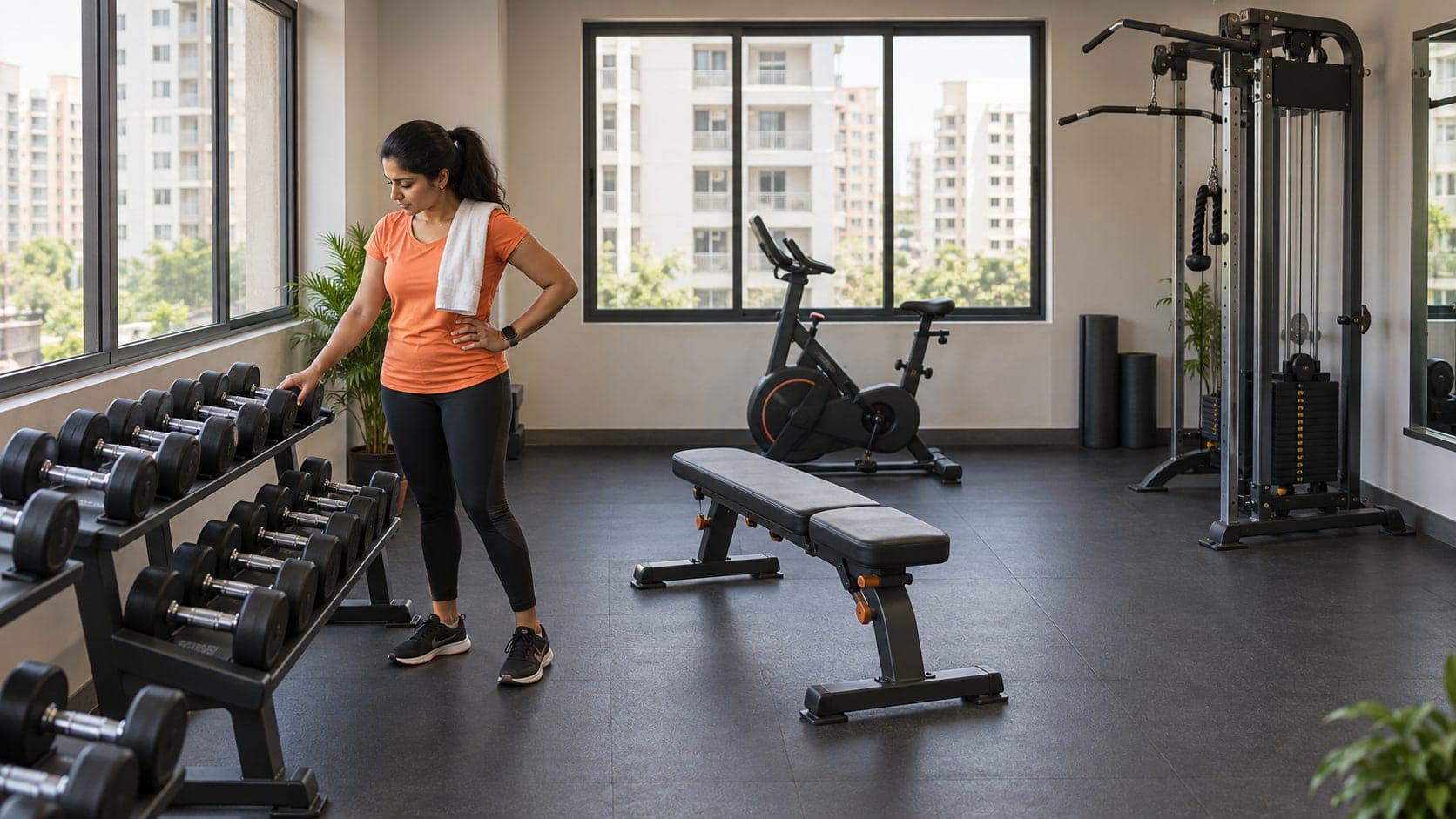
Your apartment gym may be enough if its working equipment, available resistance, space and access rules support the exercise you want to do. A commercial gym becomes worth considering when it solves a specific limitation, such as unsuitable weight increments, missing instruction or equipment you cannot use at your available time.
Do not pay for a second facility just because the room downstairs looks modest. Equally, do not treat equipment listed in a society brochure as equipment you can actually use. The useful comparison is your planned session against the current room, not apartment living against a commercial gym advertisement.
What does 'enough' mean for your goal?
For general strength work, the equipment can be simple. NHS guidance on strength exercise includes bodyweight movements and resistance bands alongside lifting weights. A commercial weight room is not a prerequisite for those options, although your own facility still needs to support the activities you choose.
Make your goal concrete enough to inspect. 'Use a treadmill for walking and follow my introductory strength plan' requires different facilities from 'learn barbell lifts with a coach'. If your goal is still only 'get fit', begin with the activities you want to learn rather than the heaviest dumbbell you think you might need someday.
The NHS strength-exercise guide includes options such as sit-to-stands and wall press-ups, with instructions and illustrations. These are examples of movements that need little equipment, not a complete substitute for an individual plan or proof that every chair or wall is suitable.
What should you check in the room itself?
Take your proposed exercise list to the apartment gym and fill in the last column below. This is an inspection worksheet, not a report of facilities Fit Square has visited.
| Check | Question to answer | Record something specific |
|---|---|---|
| Working equipment | Which machines are operational today? | Machine name and any out-of-service notice |
| Resistance choices | Are there usable light options and manageable next steps? | Actual dumbbell sizes or labelled stack increments |
| Your exercise list | Which planned movements have a suitable station or alternative? | Available, alternative needed, or instruction needed |
| Adjustability | Can the seat, handles and pads be set appropriately for you? | Adjustment that needs checking with an instructor |
| Space and access | Can you use the area without blocking doors or another station? | Space constraints at your intended hour |
| Help and maintenance | Who explains use, receives fault reports and arranges repair? | Contact, staff hours and reporting method |
A missing machine does not automatically mean a missing training option. But a substitute should be one you know how to perform, not an improvised movement copied because it uses similar-looking equipment. Ask for help adapting the exercise list before deciding you need a different building.
Which apartment rules can change the answer?
Ask the society office or facility manager about access in writing where possible. A room in your building may still have limited hours, separate charges, guest restrictions or temporary closures.
- Is access included in your current maintenance payment, or is there an additional fee?
- Do tenants and owners have the same access?
- Can an outside trainer attend, and what permissions or charges apply?
- Are there resident booking slots or limits during busy periods?
- Who can help if the room is unstaffed, and what is the emergency contact procedure?
- Are there restrictions on moving benches, using personal equipment or storing belongings?
Do not assume rules are the same across societies. Ask about the apartment facility's booking rules separately from any commercial provider's entry process.
Is the limitation equipment, knowledge or availability?
If you do not know how to use what is there
More equipment may create more unanswered questions. Find out whether an induction or suitably qualified instructor is available and what it costs. Write down the help you need: setting a seat, choosing an alternative or understanding the plan. The first-time machine guide explains what to look for, but it cannot assess your movement.
If the equipment no longer suits the plan
Identify the exact constraint. Are the available weights inappropriate for the exercise, are the jumps too large, or is a required setup absent? Ask whether the plan can be adapted using the current equipment. There is no universal dumbbell-weight threshold at which everyone needs a commercial gym.
If you cannot get a turn
Observe the room at your likely workout time, not only when it is empty. Record which station blocked the session and whether a workable alternative time exists. A commercial gym can be crowded too; verify that it resolves the same problem before paying.
What would a fair comparison look like?
The following cases are illustrative, not member stories or descriptions of actual gyms.
- The existing room is sufficient: an adult has a plan using the room's available dumbbells, bench and cardio equipment, understands the setup and can use them during the available slot. There is no identified reason to buy another membership.
- The missing service is instruction: the equipment fits the planned session, but nobody has explained it. Compare the cost and availability of an authorised instructor with an induction elsewhere before buying duplicate access.
- A commercial gym fills a documented gap: a reader wants supervised instruction on a particular lift that the apartment facility cannot accommodate. Compare venues offering that equipment and verify the instructor's availability and separate charges.
A mixed arrangement can also be reasonable: use the apartment room for some activities and another venue for a specific need. Write down which activity belongs where. Otherwise, two access options may simply produce two places you are uncertain how to use.
How should you compare the extra cost?
If the apartment access charge is unavoidable within your existing maintenance payment, separate it from the additional money needed for another gym. Then include travel, any joining charge and any coaching you intend to buy. Do not describe the apartment room as universally free or assume a commercial plan includes personal training.
Fit Square uses prepaid packs of 30, 60, 90 or 180 sessions, not a standalone single-session purchase. Sessions never expire, and one completed gym visit consumes one session. An occasional supplement to apartment training still involves that upfront pack commitment. Compare it with a gym's own directly sold visit or membership using current terms, without assuming either will be cheaper.
For broader venue checks, use what to check before joining a gym. If you are deciding between exercising inside your home and going elsewhere, the home-versus-gym guide covers that different question.
What should you do with your completed checklist?
If every essential need has an acceptable answer, keep using the apartment gym. If a gap remains, take that exact requirement to a shortlist from the Fit Square directory. Use the Fit Square app to check compatible access, then confirm the equipment and support with the venue. The reason to pay more should be a verified improvement you will use, not simply a longer equipment list.