
Chest Press Machine for Beginners: Setup and What to Ask the Floor Trainer
A chest press is not ready just because the seat feels comfortable. Compare fixed and user-defined pressing paths, separate handle height from starting depth, and prepare a short orientation conversation using official instructions rather than assuming every machine fits everyone.
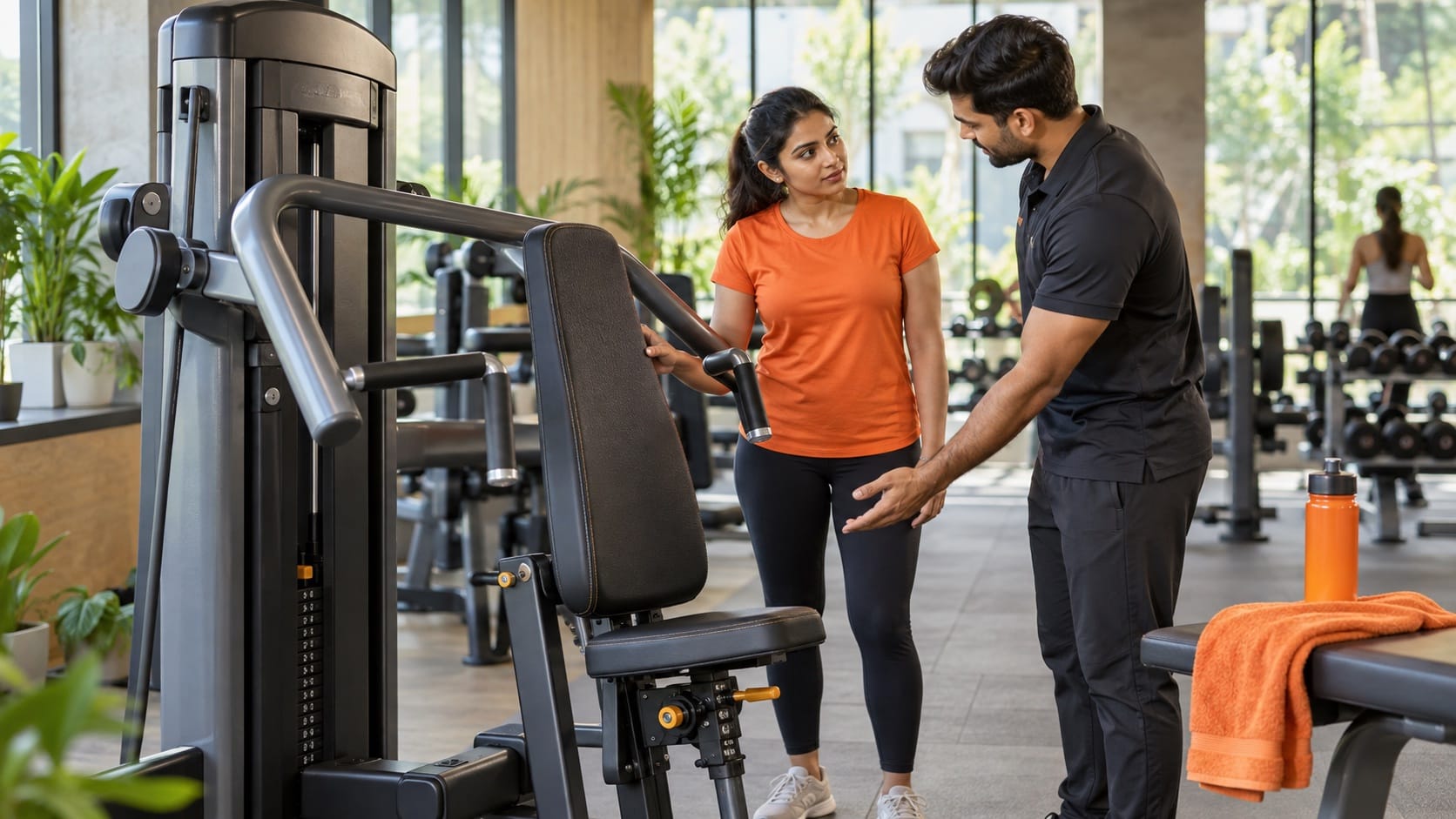
On a chest press machine, seat height and starting depth are separate setup questions. First identify the model and its controls, then ask a trainer to check how you reach the handles, use the supports and finish. Do not treat the previous user's seat number as a setting for your height.
This checklist distinguishes a conventional supported chest press from a dual-axis version. Use the matching instructions and obtain individual instruction for fit, comfortable range and practice resistance; similar-looking machines can have different paths and controls.
Check that it is the exercise you intend
A seated chest press, a shoulder press and a pectoral-fly machine can all have seats and upper-body handles. Their intended movements are different. Read the name and instructions rather than guessing from upholstery or where other people are using the handles.
Also establish whether resistance comes from a selectorised stack or loaded plates. That tells you which resistance controls need explaining, but does not tell you whether the machine's fit or path suits you. The machine overview covers those broad categories.
Two real chest presses, two different paths
The Life Fitness Insignia Chest Press SS-CP has independent converging arms. The Insignia Dual Axis Chest Press SS-CPX instead allows user-defined convergence and has an overhead pressing-depth adjustment accessible from the seat. The difference changes which path and starting-position controls you need to learn.
| Feature | Why it changes the conversation | Question for staff |
|---|---|---|
| Independent converging arms | The handles do not behave like one shared straight bar. | How should both arms move on this model? |
| User-defined convergence | The path is not fully determined in the same way. | Which movement are you teaching me to control? |
| Separate pressing-depth control | Seat height alone does not choose the starting reach. | When and how should this adjustment be made? |
A photo showing two similar-looking seats does not reveal these differences. Identify the model code and match the operating instructions before deciding which controls to touch.
Handle height is not handle depth
Seat height affects the vertical relationship between your torso and the handles. Starting depth concerns how far back or forward the handles begin. A suitable handle height does not automatically solve an awkward starting reach.
| Setup check | What to compare | What would remain unresolved |
|---|---|---|
| Seat height | Handle height relative to the torso in the intended seated position. | Handles remain too far back or difficult to reach. |
| Starting depth, if adjustable | The intended handle access and pressing start. | The seat height or foot support still does not fit. |
| Back and foot support | Whether the intended supports can be used through the task. | A reach obtained only by leaving the support. |
| Arm path | Converging arms on SS-CP versus user-defined convergence on SS-CPX. | A familiar seat with an unfamiliar movement task. |
The SS-CPX's overhead depth control is a separate feature. Identify how and when it may be adjusted and how its position is secured; do not move it by analogy with the seat lever on another model.
Check the conventional supported version against ACE
ACE's official seated chest-press reference illustrates a conventional supported version. Use it to compare these points with your machine:
- Starting position: the reference places the handles around mid-chest height and not behind the front-of-chest starting level. Check the version and available adjustments rather than translating this into a universal seat number.
- Support: feet are secure on the intended floor or foot rests, with the back supported. Reaching the handles should not require abandoning that checked support.
- Grip: ACE describes a full grip with the wrists in line with the forearms. Identify the intended handle option instead of selecting an unfamiliar grip during the attempt.
- Press and return: the reference describes controlled movement and an extended endpoint without forcing the elbows into a lock. The return is part of the same task, not permission to let the handles pull you backwards.
Check access before adding resistance. Learn the machine's intended start and finish, including any assistance mechanism actually provided. A conventional reference does not establish the user-defined path or adjustment sequence for SS-CPX.
Complete the operating checks
- Identify the model and whether the arms have a defined converging path or user-defined convergence.
- Locate the seat control and any separate starting-depth control.
- Confirm that fit adjustments lock and that resistance is resting before changes.
- Identify how the handles are reached, returned and left at the end.
- Have the setup checked at a manageable practice resistance before treating it as ready for working sets.
If a starting-position detail is unclear, resolve that specific point before a set rather than making several adjustments under load. Floor orientation and ongoing paid coaching are different arrangements; the trainer-quotation guide explains what to clarify when arranging more support.
What to observe during the practice attempt
The observation should cover access, movement and exit, not only whether the handles move forward. Ask the trainer whether the setup remains as taught on the return, and what would show that you should stop and reset before another attempt.
If you have to leave the support or change your body position to complete the movement, stop and ask for the task and resistance to be checked. Do not try to solve it by adding speed or asking another member what kilogram number they use.
The beginner starting-weight guide explains load choice without a universal chart. Here the goal is learning an exercise you can control, not testing maximum strength on an unfamiliar machine.
When another option may be the better decision today
For example, if the seat and available starting-depth adjustments still do not allow a comfortable setup, consider another appropriately taught pressing option. Do not force yourself to fit a machine simply because its exercise name appears in the plan.
Likewise, you do not need to progress to a less constrained design simply because it exists. If you are learning the SS-CP, a neighbouring SS-CPX is a new operating and movement task, not automatically the next level.
If the exercise causes pain, stop and seek appropriate advice; do not diagnose the cause from handle height. Persistent or recurring symptoms need healthcare assessment. NHS guidance supports urgent help for sudden persistent chest discomfort or chest pain with breathlessness. Never assume chest pain during a chest exercise is merely the intended muscle working.
Distinguish the version next time
Keep the model, handle option and checked height/depth settings together. An SS-CP entry and an SS-CPX entry describe different tasks, even if the displayed resistance matches. The progress-recording guide helps keep the comparison meaningful.
Confirm equipment and orientation through the Fit Square gym listings, and check eligible partner access in the Fit Square app. Access does not include a guaranteed machine model or paid coaching.
Official references
Chest-press questions
Does every chest press have a starting-depth control?
No. Identify the controls actually provided on your machine.
Is a dual-axis machine automatically better?
No. Its user-defined path is a different task to learn, not a universal upgrade.
Can seat height solve every reach problem?
No. Height and starting depth need separate checks where the equipment provides those adjustments.
What should I do if the machine remains uncomfortable?
Stop and ask for the fit to be checked or an appropriate alternative. Do not force a painful movement.