How Much Weight Should a Beginner Lift?
There is no useful universal beginner kilogram chart. Learn to match resistance to an exercise and rep target, interpret machine labels and decide what to adjust.

A beginner should use a weight they can control for the repetitions in an appropriate plan, with technique intact and without pain. That may be a light dumbbell, a machine's low setting, a resistance band or no added weight. There is no single starting kilogram value that fits every adult or every exercise.
The useful question is not 'What should someone like me lift?' It is 'What resistance lets me practise this exercise correctly at the intended effort today?' This is general adult education. Rehabilitation, medical restrictions and unexplained symptoms need individual professional advice.
Why is a beginner kilogram chart not enough?
A chart cannot see your movement, know your training history or identify the equipment you are using. It also cannot tell whether a listed dumbbell value means each hand or the pair. A label such as 'beginner woman' or 'beginner man' does not resolve any of those questions.
The American College of Sports Medicine's 2026 guidance emphasises individualisation by goals and circumstances. Its recommendations about optimising particular outcomes should not be read as a requirement for a new gym user to lift near their maximum. Training to failure is not a universal requirement either.
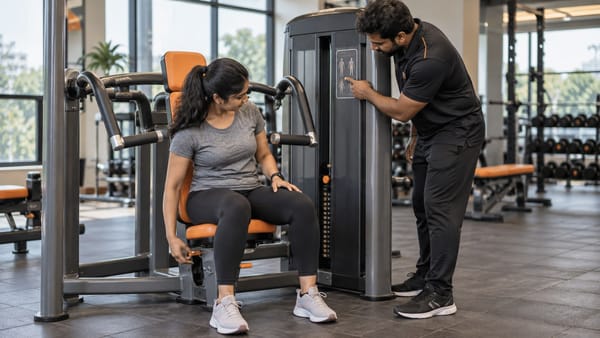
Choose the exercise and learn it before making the number the main task. If you are unsure how to position a seat or pad, start with the machine-setup guide. More weight cannot resolve an unclear setup.
What repetition target should the weight match?
First, read the plan. A load chosen for a short set is not automatically suitable for a longer one. If sets and repetitions are unclear, use our workout-card explainer before changing resistance.
Mayo Clinic describes 12-15 comfortable repetitions as a general starting guide. That is not a mandatory range for every person, exercise or goal, and it is not an instruction to force the final repetition.
ACE's load-selection resource gives an 8-12-repetition example for average healthy adults, with challenge towards the end, and cautions against maximum-load testing for most people. The exact range can differ between appropriate programmes. Both references make more sense as guidance about matching resistance to a task than as a universal kilogram table.
How can you find a starting load without a maximum test?
Use a qualified instructor to help with the initial choice when you are unfamiliar with the movement. Here is a practical process to discuss with them, not a test protocol you must complete in one visit:
- Identify the exact task. Name the exercise, equipment, target repetitions and intended effort.
- Learn the setup and finish. Know how to begin, put the load down or return the machine to rest, and exit.
- Use a manageable practice attempt. Let instruction and observed control guide the starting resistance rather than copying another user's setting.
- Describe what happened. Report whether the movement felt controlled, unusually difficult, unclear or painful.
- Agree on the next attempt. That may mean the same load, a lower load, a different setup or a different exercise, not necessarily more weight.
You do not need to keep trying heavier options until one fails. An uncertain first attempt can simply remain a practice attempt. Ask the instructor to explain the reason for a change so you can recognise the same situation later.
What would those decisions look like in practice?
These are illustrative conversations, not recorded coaching sessions or results. They show what information to report, not weights to copy.
| What you notice | Useful description | What to discuss |
|---|---|---|
| You cannot reach the handles comfortably. | 'The starting position feels wrong before I even begin.' | Check fit and exercise choice before treating this as a strength problem. |
| You have to swing or change position to continue. | 'I cannot repeat the same movement with this setting.' | Whether the load, repetitions or technique need adjustment. |
| The planned set is comfortable throughout. | 'I finished the target and could have done more controlled repetitions.' | Whether this is suitable practice or whether a later small increase fits the plan. |
| You feel sharp or recurring pain. | 'This movement hurts; I am stopping.' | Healthcare assessment when appropriate, not a challenge to push through. |
Do not turn the third row into an automatic rule to add weight immediately. You may still be learning the exercise. Conversely, the first row should not be answered with 'try harder': fit is a separate question.
How much effort should be left at the end?
Some plans use repetitions in reserve, or RIR, to describe effort. As Newcastle Hospitals explains, this is an estimate of further repetitions you could complete with good form. If your instructed target is two RIR, you estimate that two controlled repetitions remain. It does not mean 'add two more'.
When you cannot judge that estimate, say so. A coach can help interpret your effort, but a number alone cannot prove that the movement is appropriate. Stopping before a failed repetition is an available choice; you do not need to fail a lift to validate your estimate.
Why can the same machine number feel different elsewhere?
Cable systems are not all mechanically identical. Life Fitness explains different motion ratios on Cybex equipment, including 2:1 and 4:1 designs. The relationship between stack movement and handle movement therefore varies, and the manufacturer's label needs to be read in context.
The practical implication is to treat a new machine as a new setup, not a reliable test against a number from another model. Do not automatically divide a label by two: check what the displayed value represents. For tracking, write the machine name, displayed number, unit and attachment alongside repetitions.
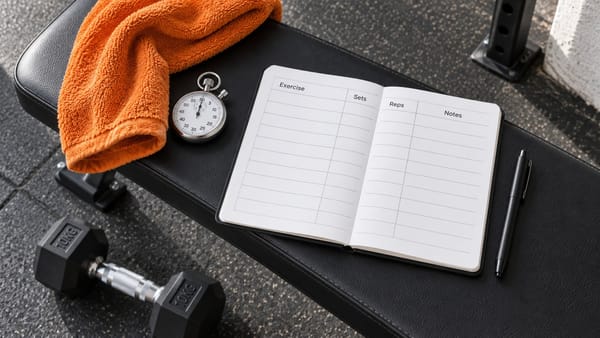
With free weights, make the unit equally clear: '4 kg each hand' is different from '4 kg total'. This is a recordkeeping example, not a suggested starting load. Numbers become useful only when they describe the same task.
When should you increase the weight?
Ask what progression rule belongs to your programme. Being able to repeat the intended work with consistent technique and the intended effort is more useful information than the date on the calendar. The answer may be to repeat the load or add a repetition within the existing range before considering more resistance.
There is no need for an automatic weekly increase. If the smallest available jump is too large, report that equipment limitation. Ask about an approved smaller increment or another suitable option; do not attach improvised objects to a machine. Do not increase weight, repetitions and sets together simply because all three fields are editable.
For the equipment-selection side of this problem, the beginner strength-gym guide explains why usable lighter weights and adjustable equipment matter. Browse the Fit Square directory or Fit Square app, then check the actual equipment and any coaching charges with the gym. A compatible access tier is not a promise of included personal training.