
What Should You Track in Your First Month at the Gym?
Keep a useful record of visits, equipment settings, repetitions, effort and questions. A completed illustrative log shows what to record and what the numbers cannot prove.
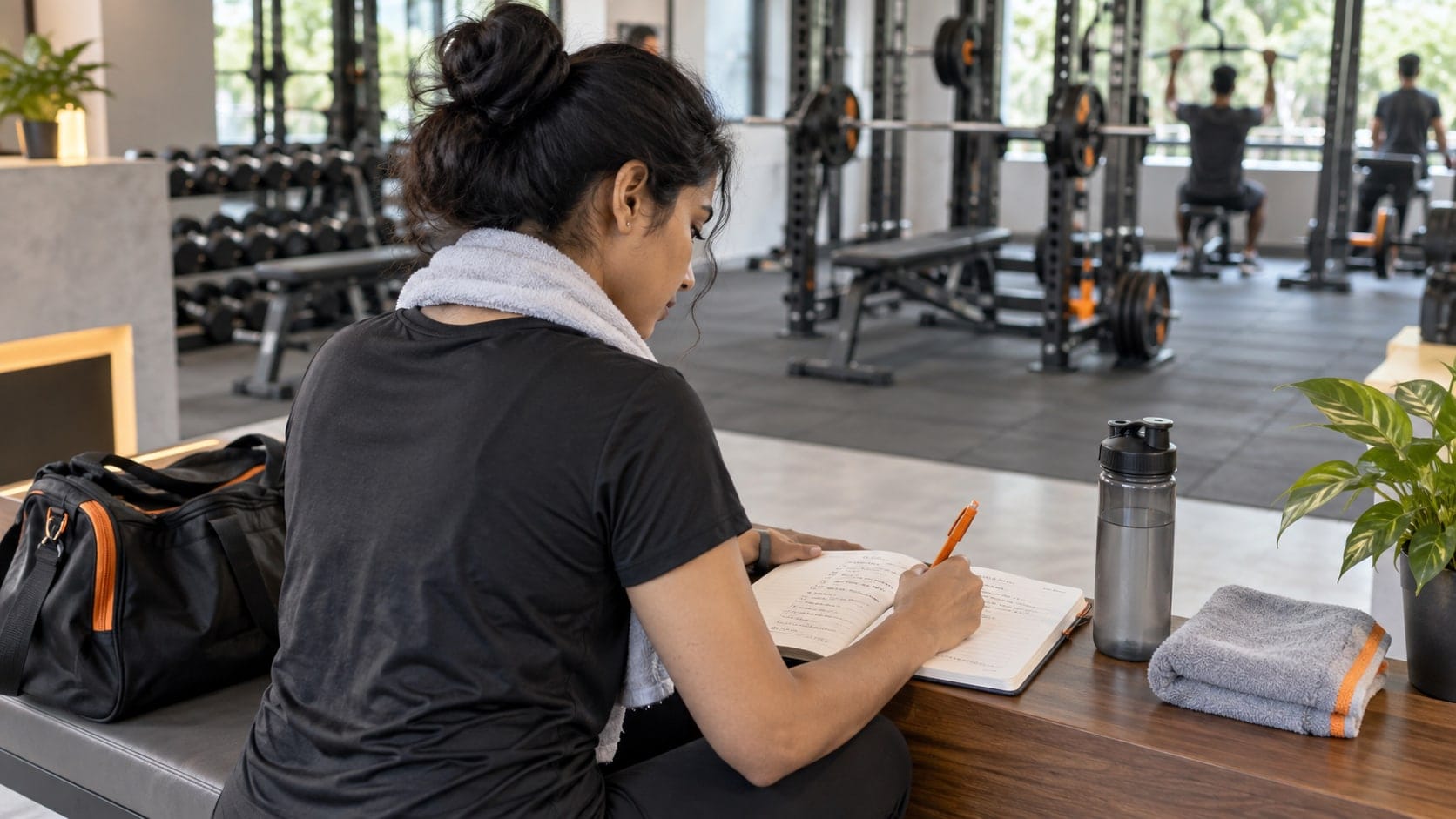
In your first month, track what helps you repeat and understand the next workout: completed visits, the exercise and equipment used, settings, resistance, repetitions, rest and any question or symptom worth following up. Add a brief note about how the session felt. You do not need a dashboard of body measurements to make the record useful.
NIDDK's guidance on changing habits recommends recording both what you did and how you felt, then reviewing progress and obstacles. The log below applies that idea to an ordinary gym routine.
What belongs in the smallest useful log?
Use two levels of detail. The session note explains whether the visit happened and what affected it. Exercise entries explain what you actually did. This keeps a calendar full of check-ins from being mistaken for a complete training record.
- Session: date, location, planned or unplanned visit, and roughly how long you trained.
- Exercise: a recognisable name, equipment identity and any relevant setup.
- Work completed: resistance with units and actual repetitions in each set.
- Context: approximate rest, effort in plain language, and anything that changed.
- Follow-up: one concrete question, difficulty or symptom rather than a vague 'bad workout'.
A phone note or small notebook can do this. Choose something you can update after returning the equipment safely. An entry you understand later is more useful than a detailed form you abandon because it takes too long.
What does a completed exercise log look like?
All examples in this guide are fictional. The loads, settings and repetitions demonstrate recordkeeping, not a workout to follow. Warm-up and other exercises are omitted to keep the log readable.
| Exercise and setup | Actual work | Rest and effort | Note for next time |
|---|---|---|---|
| Seated chest press, same machine as last visit; seat 3 | Stack label 10 kg; 10 reps, then 9 | About 2 minutes; final reps felt challenging | Ask whether handle starting position is appropriate |
| Seated row; chest support 2 | Stack label 15 kg; 10 reps, then 10 | About 2 minutes; movement stayed controlled | Record this model name before using another row machine |
| Dumbbell curl, seated | 3 kg per hand; 8 reps, then 8 | About 90 seconds; effort estimate uncertain | Ask how the planned stopping point should feel |
For two dumbbells, '3 kg per hand' and '6 kg total' describe the same pair; stating the convention avoids ambiguity. For a barbell exercise, specify whether the recorded number includes the bar. If a machine displays pounds, record pounds rather than silently treating the number as kilograms.
Keep actual repetitions separate from the target. Writing '2 x 10' when you completed ten and nine loses useful information. The workout-notation guide explains how to read the prescribed version; your log records what happened.
Why record the equipment and its settings?
Because the weight number alone may not describe the same task elsewhere. Life Fitness explains how pulley ratios alter effective resistance. That is one reason two stack labels cannot be treated as a universal strength comparison.
Use an identifiable description such as the manufacturer and exercise name, plus your relevant settings. Do not assume seat 3 on one machine means the same position on another. At a different venue, ask about the setup and appropriate starting resistance instead of copying the previous entry automatically.
A photograph of the equipment label may be convenient if the venue permits it and no other person is included without consent. You do not need to film strangers or record a full workout to maintain a useful log.
What should the visit note say?
| Visit | What happened | Useful follow-up |
|---|---|---|
| First planned visit | Attended; spent extra time finding and adjusting equipment | Leave setup time in the next appointment |
| Second planned visit | Did not attend; work meeting ran late | Check whether a different available slot is realistic |
| Next completed visit | Attended; usual row machine was occupied, alternative used | Mark it as a different exercise entry, not a new personal record |
Keep the note descriptive. 'Work meeting ran late' is more informative than 'lazy'. An illness-related absence should be recorded as such; the log should never instruct you to make up missed exercise before you have appropriately recovered.
If you track aerobic activity, record the activity, duration and an understandable description of effort separately. CDC guidance distinguishes weekly aerobic activity from muscle-strengthening days. Forty minutes inside a gym is not automatically forty minutes of moderate-intensity aerobic work.
How can you tell whether a comparison is fair?
Compare entries with enough shared context. The same exercise, machine, settings and approximate rest make the comparison easier to interpret. A new weight number after changing the machine, movement and technique is not a clean like-for-like result.
Reading the log: one entry shows ten and nine repetitions; a later entry shows ten and ten on the same setup. That is one more recorded repetition under apparently similar conditions. It is not, by itself, proof of measured muscle growth, a guaranteed trend or an instruction to increase the load.
If an instructor confirms that technique is more consistent, record the specific observation. 'Returned the weight without rushing' is more useful than awarding yourself a perfect-form score. For progression decisions, take the record to a qualified instructor and use the starting-weight guide as background.
What should you leave out?
You can omit anything that does not help your current goal or an agreed care plan. Daily photographs, a calorie-burn score, public leaderboards and a running total of every kilogram moved are not necessary to remember your exercises or questions.
Body weight and measurements are optional unless you are tracking them for a specific reason with appropriate guidance. They do not tell you whether you learned a machine adjustment or made a planned visit. Avoid turning the log into a compulsory comparison with another person's body or lifts.
Do not invent missing entries from memory to make the record look complete. Mark them unknown. Keep personal health details private and share only what is useful with the professional helping you.
When should a note become a request for medical help?
Do not wait for the month-end review when symptoms need attention. Stop an activity that causes pain and seek appropriate assessment for persistent or recurring symptoms. CDC advises immediate medical care for warning signs such as muscle pain more severe than expected, tea- or cola-coloured urine, or marked weakness. You do not need all of them, and a workout log cannot diagnose their cause.
If tracking creates a feeling that you must exercise despite illness or injury, discuss that with a healthcare professional. MedlinePlus identifies exercising while injured or sick and feeling out of control about exercise as reasons to seek help. Simplify or pause optional tracking rather than treating a streak as an obligation.
What should you review at the end of the month?
Prepare a short summary: visits planned and completed, equipment you can now identify, questions still unresolved, and any recurring access problem. Keep medical questions separate from scheduling questions. For the broader process of settling into a routine, see the first-month consistency guide.
Session balance example: a single person who starts with a 30-session Fit Square pack and completes seven gym visits uses seven sessions and has 23 remaining, assuming no other deductions or use. Those remaining sessions never expire. This describes the balance, not a discount or a claim that the entire pack was consumed in the first month.
Use your own attendance and access records to plan the next month in the Fit Square app. If the recurring problem is the location or equipment, compare alternatives in the gym directory. Keep the exercise log wherever it is easiest to maintain; this guide does not assume the app records sets or technique for you.