
Machines vs Free Weights for Beginners: What Actually Matters?
You can begin with machines, free weights or a mixture. Compare the actual exercise, fit, setup, available loads and help instead of choosing a side.
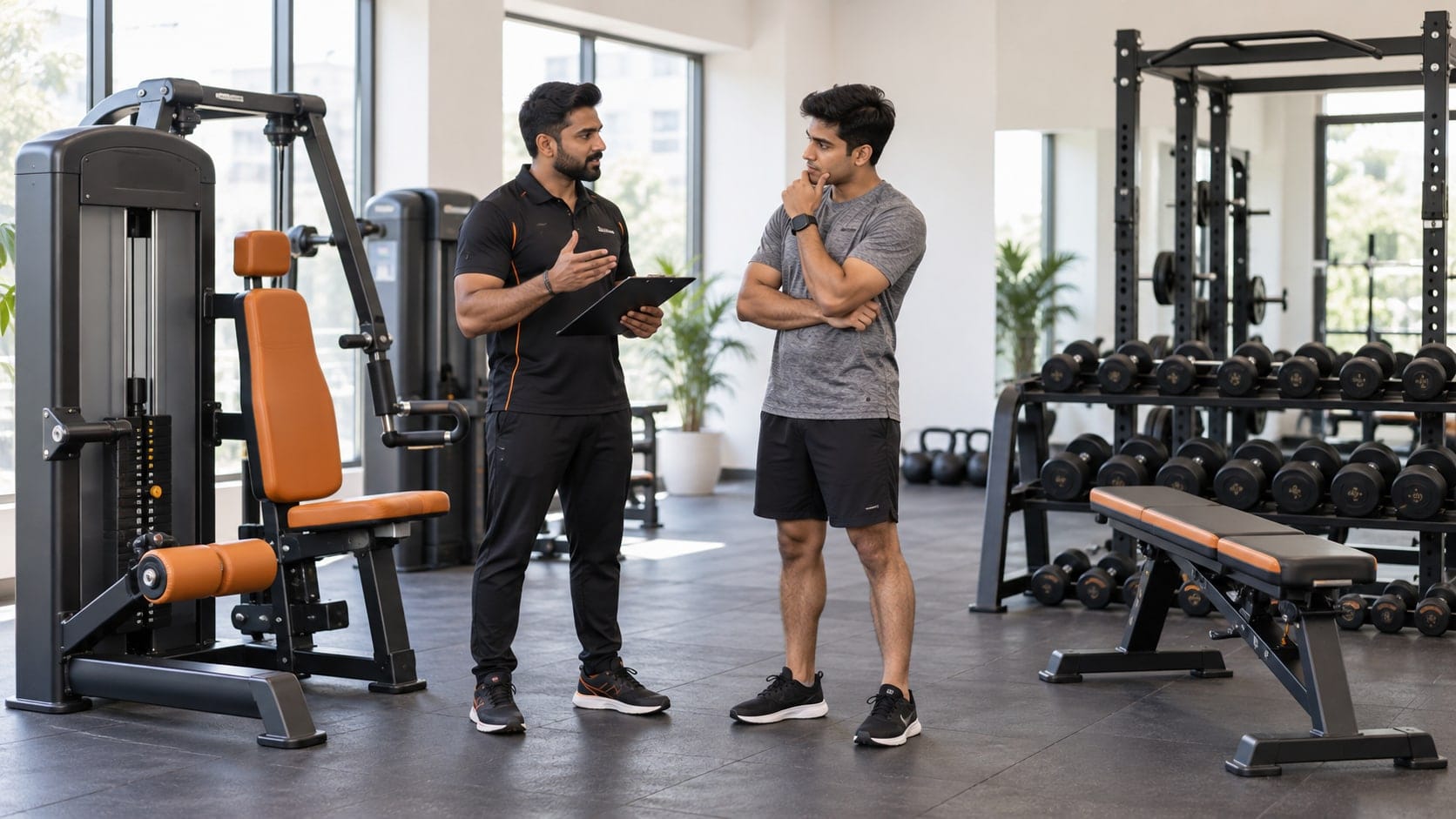
Beginners can use machines, free weights or a combination. Neither category is a compulsory starting point, and machines are not something you must eventually outgrow. Choose the exercise and setup you can learn, control and repeat with an appropriate level of help.
The ACSM's 2026 resistance-training update reports that equipment type did not consistently determine outcomes for the average healthy adult. That is not a declaration that every machine and free-weight exercise is interchangeable, or that either is automatically safe.
What are you actually comparing?
Free weights include dumbbells, barbells and kettlebells: the equipment does not fix the whole path of the movement for you. Machines are a wider group than the name suggests. Some use a seated support and lever arms; others use adjustable cables. Some have a pin-selected stack; others require you to load plates.
For a real example, the Life Fitness Insignia Chest Press has independent, converging arms. The manufacturer's Dual Adjustable Pulley allows user-defined movement paths. Both are machines, but they do not make the same demands on setup or movement control. These are manufacturer examples, not a claim that a particular Fit Square partner has either model.
Likewise, comparing a supported dumbbell exercise with a complex standing barbell lift would not tell you whether all free weights are suitable for you. Compare actual movements, not the entire equipment category at once.
Can both approaches build strength?
A randomised trial in 36 novice adult men compared ten weeks of machines, free weights, or a switch from machines to free weights. The groups improved measured strength, body-circumference and functional-test outcomes without significant between-group differences. Circumference was the study's size measure; it was not a direct measurement of muscle tissue.
This small study is useful evidence against requiring every beginner to follow one equipment route. It does not predict your results, prove injury prevention, or establish the best approach for people with health conditions. No research result replaces checking whether the specific exercise suits you.
When might a machine be the convenient choice?
A supported station with an understandable adjustment system may reduce the number of things you need to organise. You can record the seat setting and selected resistance, then return to the same setup next time. That is a practical reason to choose it, not an argument that it makes technique irrelevant.
Ask yourself:
- Can I reach the handles and use the supports as intended?
- Do I know which adjustments change the starting position?
- Is the lowest usable resistance appropriate, and are the next increments manageable?
- Do I understand how the movement begins and ends?
- Can I get help with this exact model rather than guessing from another machine?
If an adjustment does not make sense, ask staff to explain it before adding resistance. The first-time machine setup guide covers the operating questions separately. This comparison is about selecting an option, not supplying universal seat or joint-position settings.
When might free weights be the convenient choice?
Dumbbells may be available when a popular station is occupied. They may also let you practise a particular exercise in a quieter space, provided that space is intended for training and the required bench or support is available.
Check the full task, not just the repetitions. Can you get the weights into position, perform the movement and put them away without improvising? Do you understand the setup and any spotting arrangements the exercise requires? The empty bar or lightest dumbbell available is not necessarily a suitable starting load for everyone.
If you specifically want to learn a free-weight exercise, request instruction in that movement. You can retain familiar machine exercises elsewhere in the programme. There is no need to change your entire routine on the day you learn one new skill.
Is one option safer?
There is no useful blanket safety ranking here. Mayo Clinic's technique guidance emphasises learning correct execution, using a controllable load and getting qualified instruction. It advises reducing load or repetitions when form cannot be maintained and stopping an exercise that causes pain.
Do not interpret discomfort as proof that a machine is adjusting your body correctly, or use heavier dumbbells to compensate for an unfamiliar movement. For persistent or recurring pain, seek assessment from a healthcare professional; changing equipment on your own is not a diagnosis or treatment plan.
In either area, ask how to end the exercise safely before starting. If you cannot answer that question, instruction matters more than the machine-versus-free-weight debate.
Can you mix them in one session?
Yes. A plan can use different tools for different jobs. The following are illustrative decisions, not complete workouts or observed client sessions.
| Situation | Reasonable question | What not to assume |
|---|---|---|
| You know a seated row but want to learn a dumbbell movement | Can a qualified instructor teach the new movement while the rest of the plan stays familiar? | Learning one free-weight exercise requires abandoning all machines. |
| The machine does not fit comfortably | Is there an appropriate adjustment or another exercise for the intended task? | The fixed path must be right for every body. |
| The next dumbbell jump is too large | Can the instructor adapt progression or use a different available tool? | A heavier pair is required because another week has passed. |
| Your usual station is occupied | Is the alternative already in your plan, with its own setup and load? | The same number of kilograms makes it equivalent. |
Why can the same weight number feel different?
A stack label is not a universal comparison with a dumbbell or another machine. Life Fitness's explanation of mechanical advantage in strength equipment shows how pulley arrangements change the force required. Even the apparent weight number needs the machine's context.
Record the equipment identity, units, setting and repetitions rather than trying to convert every exercise to a single score. At another gym, establish an appropriate load for the new setup instead of copying the old stack number. The starting-weight guide addresses that decision.
What should you look for when choosing a gym?
Look for a usable range, not the biggest display: light options, understandable machines, suitable benches, room to train and someone who can explain the equipment. Our strength-training gym checklist helps connect those needs to venue selection.
Compare nearby options in the Fit Square directory and check compatible access in the Fit Square app. Confirm equipment and instruction with each venue; access does not automatically include paid personal training. Choose the tools that fit the current plan, without treating either side of the gym as a test of experience.